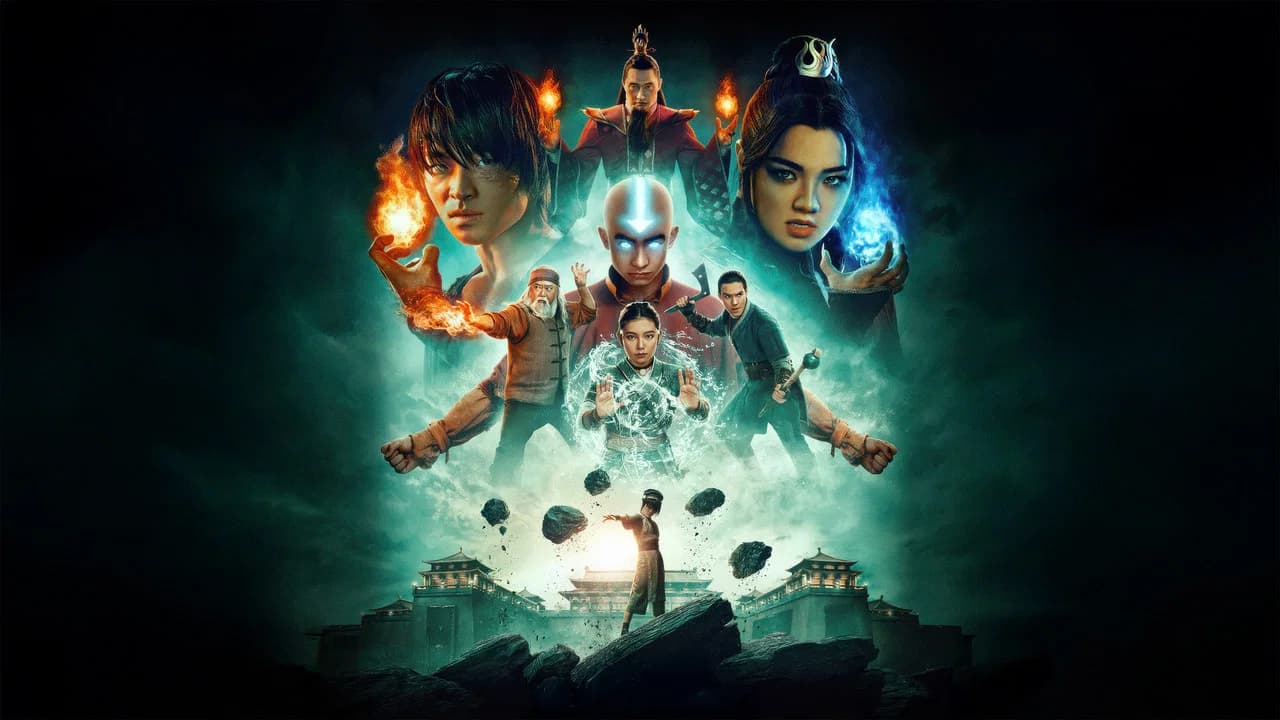
Avatar: The Last Airbender
Can Karayel • August 1, 2026
Summarize this with AI
Rating
Netflix's live-action adaptation Avatar: The Last Airbender is an ambitious production that attempts to capture the spirit of the legendary animated series. While the show, brought to life under Albert Kim's creative direction, succeeds in visual effects, it only partially reaches the depth of the original animation.
Netflix's 2024 release of Avatar: The Last Airbender is a project that dares to bring one of the most beloved animated productions of the past two decades to live action. This adaptation, with Albert Kim in the showrunner's chair, sets out with the expectations of millions of fans of the original animated series that aired on Nickelodeon between 2005-2008. However, these expectations continue to be the show's greatest burden.
The series' story begins with Avatar Aang, who can master all four elements, awakening from a hundred-year slumber in ice. The young hero, played by Gordon Cormier, must master all four elements to stop the Fire Nation's plans to invade the world. This adaptation, based on the first season of the original animation, attempts to tell the story in a more mature tone, but at times sacrifices the spiritual depth of the animation. Albert Kim's scriptwriting approach adds a darker atmosphere to the series by focusing more on political intrigue and the brutality of war. However, this choice overshadows the humor and lightness of the original production, hindering the development of some characters.
The production team's greatest achievement is visually bringing to life the cultural richness of the four different nations. The respect paid to the Asian cultures behind each element concept is felt in every detail, from costume design to set decoration. The Air Nomads' monasteries draw inspiration from Tibetan architecture, while the Fire Nation's cities are inspired by the grandeur of the Qing Dynasty. While the production design team realistically recreates the animation's iconic locations, the visual effects team delivers an impressive performance in bringing elemental bending to the screen. Water bending scenes in particular stand out as a perfect blend of CGI and practical effects.
Gordon Cormier's interpretation of Aang is one of the series' most controversial elements. While the twelve-year-old actor successfully handles the character's physical aspects, he struggles to capture the cheerful and childlike energy of Aang from the animation. The script seems to have burdened Cormier too heavily by writing the character in a more serious and responsible tone. Kiawentiio's Katara performance is more balanced; she successfully reflects the determination and emotional depth of the young Water Tribe warrior. Ian Ousley's Sokka moves away from the original character's comedic aspects, portraying a more mature warrior, which has led to divisions among fans. Dallas Liu's interpretation of Prince Zuko is the series' strongest performance; he conveys the character's internal conflict and search for honor in a layered manner.
Cinematographically, Avatar: The Last Airbender meets the standards of modern fantasy series. The camera work is dynamic and fluid, especially in fight scenes. The choreography of bending scenes draws inspiration from real martial arts; water bending from Tai Chi, earth bending from Hung Gar Kung Fu, fire bending from Northern Shaolin. This detail is commendable in terms of staying true to the cultural authenticity present in the original animation. In the music department, there's an approach inspired by Jeremy Zuckerman's original themes, but it cannot be said that the series has fully established its own musical identity.
Looking at behind-the-scenes information, the eight-episode first season's budget is estimated at approximately $120 million. This figure equals $15 million per episode and supports the series' visual ambitions. An interesting detail: Gordon Cormier's casting process took place online during the pandemic and he was selected from among hundreds of young actors. The actors received real martial arts training to prepare for their roles; Cormier in particular performed 70% of his own stunt scenes throughout the series. The production team preferred to use practical effects whenever possible alongside CGI effects; a giant puppet was produced for some of Appa's scenes.
One of the series' most controversial aspects is the pacing problem in storytelling. The effort to compress the animation's twenty episodes into eight episodes limits the development of some characters and subplots. Particularly the mythological depth and spiritual dimension of the Avatar world are handled more superficially. Fundamental elements of the original series such as Sokka's character development and Aang's cheerful personality have been softened, which brings a critical perspective to the series.
Considering Netflix's local popularity in Turkey, Avatar: The Last Airbender is expected to resonate especially with the young adult audience. For a nostalgic generation that grew up watching the original animation, this adaptation is both exciting and potentially disappointing. However, when evaluated on its own merits, it's undeniably a quality fantasy production. Production values are high, casting choices are bold, and visual storytelling is impressive. The problem is having to constantly live in the shadow of the animation.
In conclusion, Avatar: The Last Airbender is a commendable adaptation effort, if not perfect. The world created by Albert Kim and his team revives the Avatar universe for a new generation by using the possibilities of live action while preserving the universal themes of the original animation. The second season renewal demonstrates the producers' determination to expand this universe. Perhaps over time, the series can emerge from the animation's shadow and find its own identity.
Frequently Asked Questions
Where can I watch Avatar: The Last Airbender live-action series?
Avatar: The Last Airbender (2024) is available exclusively on Netflix. The live-action adaptation was produced as a Netflix original series.
Is Avatar: The Last Airbender 2024 based on the animated series?
Yes, the 2024 live-action Avatar: The Last Airbender is a direct adaptation of the beloved Nickelodeon animated series that originally aired from 2005 to 2008. It retells the story of Aang and his journey to master all four elements.
Is Avatar: The Last Airbender worth watching?
With a FoxFilm score of 7.3/10, Avatar: The Last Airbender is worth watching as an ambitious production that attempts to capture the spirit of the legendary animated series. While it may not fully replicate the original's magic, it offers a visually impressive take on the beloved story.
Who is the creator of Avatar: The Last Airbender 2024?
The 2024 live-action Avatar: The Last Airbender series was created by Albert Kim, who served as showrunner and executive producer. Kim adapted the original animated series created by Michael Dante DiMartino and Bryan Konietzko.