You Can See Everything
Can Karayel • November 27, 2026 • Written with AI assistance
You Can See Everything: plot in brief
You Can See Everything follows Elizabeth Holmes, who, thirty-four days before going to prison, invites a skeptical film crew to document her every move. What begins as an intimate portrait stretches over three years, blurring who is watching whom.
Summarize this with AI
Want to see more FoxFilm reviews in your Google results? Add us as a preferred source.
Add FoxFilm as a preferred source on GoogleRating
In his 175-minute documentary Her Şey Ortada (You Can See Everything), Nathan Fielder follows Elizabeth Holmes through her last thirty-four days before prison and the three years after. A film in which reality and fiction, confession and performance are intertwined, it is one of the most controversial documentary experiments of 2026.
INTRODUCTION: TO OBSERVE OR TO BE OBSERVED?
Silicon Valley's most expensive lie has been the subject of documentaries, podcasts and series for years. Alex Gibney's The Inventor, The Dropout podcast and the Emmy-winning series starring Amanda Seyfried had already turned the Elizabeth Holmes story into a classic rise-and-fall narrative. Her Şey Ortada (You Can See Everything) builds on all of that and changes the central question: when you put a liar in front of a camera, do you capture the truth, or just a new version of the lie? In Nathan Fielder's hands, this question becomes an experiment that runs close to three hours, as unsettling as it is mesmerizing.
Story and screenplay analysis
The plot summary sounds innocent. With thirty-four days left before she goes to prison, Holmes invites a skeptical film crew to document her every move. What begins as an intimate portrait grows into a journey spread over three years. The film's first big move is to blur who is watching whom. Holmes opens her doors to the camera to manage her own image, but Fielder's team is smart enough to use that openness as a trap as well. It is no accident that voyeurism and reenactment are among the film's keywords. The film makes the viewer both a voyeur and an accomplice.
The marriage, the quiet landscape of Texas and the shadow of the past in California split the narrative into three distinct layers. The screenplay's greatest strength is that it never hands down an easy verdict. Holmes is neither demonized nor exonerated. In every scene, the viewer is forced to question their own instincts. This ambiguity is what separates Her Şey Ortada from ordinary true crime consumption.
Direction and cinematography
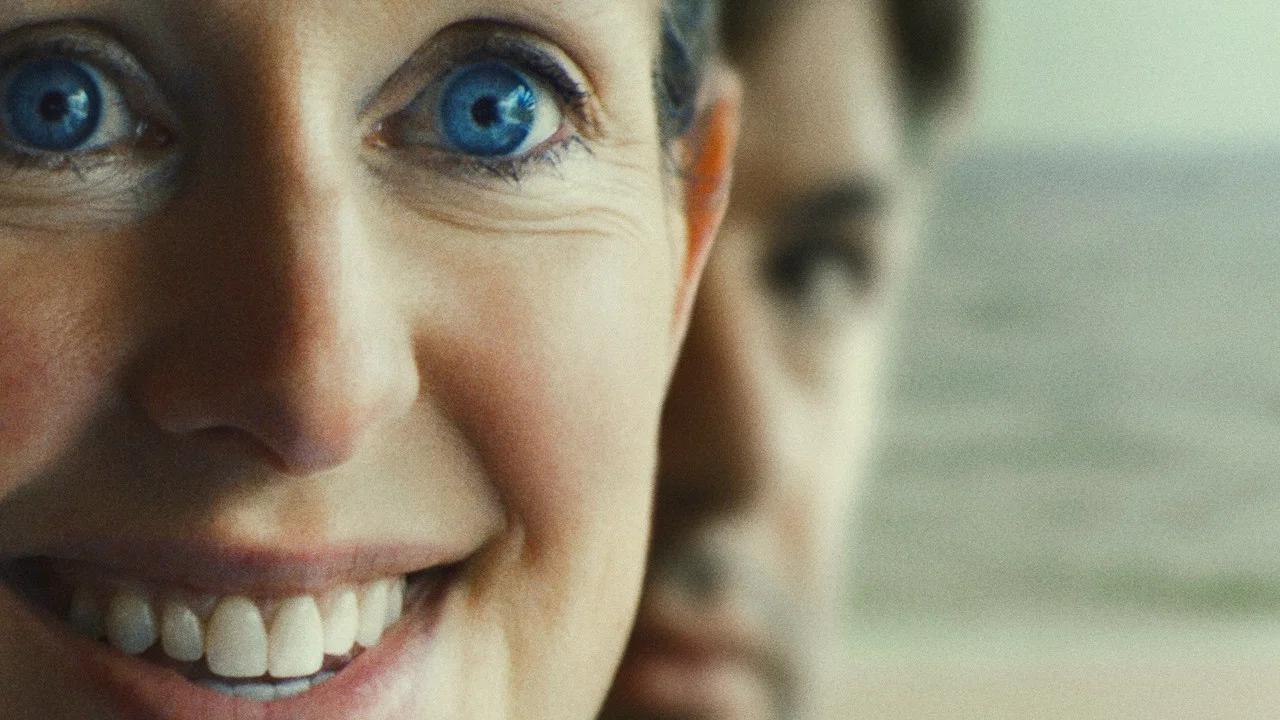
Fielder takes the method we know from Nathan for You and The Rehearsal onto darker ground here: setting up the scene, repeating it, testing the truth by rehearsing it. The deadpan expression, the silences held longer than necessary and the deliberately placed awkward pauses are his signature language. This time, comedy gives way to anxiety. The camera is often too close and too patient. The way someone holds a coffee cup, or a glance that slips away mid-sentence, can change the meaning of an entire scene.
The visual language turns the claim in the film's title on its head. Everything seems to be in plain view, yet we keep wondering what lies outside the frame. The sterile lighting in the domestic scenes recalls Silicon Valley's aesthetic of glass and concrete, while the Texas sequences have a rawer, drier look. This visual divide, the move from East to West, also reflects the character's inner collapse.
Performances
Talking about performance in a documentary may seem odd, but in this film that is exactly the point. Elizabeth Holmes is watched like someone playing herself. Every sentence is measured, every smile rehearsed. Fielder, meanwhile, uses the character he created, the controlled incompetent, almost as a mirror this time. Billy Evans's presence forms the film's human center. The small gestures in the family scenes say more than the big narrative does.
The participation of Amanda Seyfried, Christopher Abbott and Lance Oppenheim is one of the elements that keeps the film in the gray area between fiction and documentary. For viewers familiar with Seyfried's take on Holmes in The Dropout, her involvement creates a strange mirror effect: the real person comes together with the actor who played her, in the same universe.
Technical details
The editing is the film's real hero. The 175-minute running time is daunting at first glance, but the rhythm is deliberately stretched out and unnerving. Long takes test your patience, and the short cuts that follow suddenly ratchet up the tension. Considering the three-year shoot, achieving such a consistent flow is a serious editing accomplishment. The music, meanwhile, is deliberately kept in the background. Minimal synthesizers and ambient textures create unease rather than steering emotion. In some scenes, silence is the most powerful piece of music.
Behind the scenes and fun facts
Holmes was convicted of fraud in 2022 and sent to the federal women's prison in Bryan, Texas, with a sentence of roughly eleven years. The film's thirty-four-day countdown is based on this real timeline.
The logic of rehearsal that Fielder used in The Rehearsal is at work here too. The director's method of acting out real-life situations in advance to test how people will react forms the basis of this film's dramaturgy.
Lance Oppenheim is a documentarian known for works like Some Kind of Heaven and an expert at blending reality with cinematic construction. His involvement in the production helps the film take on a structure that looks at its subject from both the inside and the outside.
Conclusion and cultural impact
With a score above 8.6 on TMDB, Her Şey Ortada is not merely a scandal narrative but an experiment on our age's obsession with visibility. For Turkish viewers, this theme is far from foreign. From reality shows to social media confessions, we live in a culture where everything is watched and put on display. Is the person in front of us really showing themselves, or the person they want to be seen as? The film doesn't answer this question, but it insistently holds the question itself up to our faces.
It is not flawless. The running time strains patience in places, and Fielder's style may not appeal to everyone's taste. But Her Şey Ortada deserves to be counted among the year's boldest, most unsettling and most talked-about documentaries. Speaking as a film historian, it opens up a new vein between Errol Morris's interrogative cinema and Andy Kaufman's boundary-defying approach to performance.
Frequently Asked Questions
What is You Can See Everything about?
Nathan Fielder's documentary follows Elizabeth Holmes through her last thirty-four days before prison and the three years after. Holmes invites a skeptical film crew to document her every move. The film blends reality and fiction, confession and performance.
What genre is You Can See Everything?
You Can See Everything is a documentary.
Who directed You Can See Everything and what is his style?
The film was directed by Nathan Fielder. He brings the method of Nathan for You and The Rehearsal onto darker ground: setting up a scene, repeating it, and testing the truth by rehearsing it. The film also relies on deadpan delivery and silences held longer than necessary.
How long is You Can See Everything?
The documentary runs 175 minutes. That is close to three hours, covering Holmes's final thirty-four days before prison and the three years that follow.
What language is You Can See Everything in?
You Can See Everything was originally made in English.
Who is in the cast of You Can See Everything?
The cast includes Elizabeth Holmes, Nathan Fielder, Billy Evans, Amanda Seyfried and Christopher Abbott.