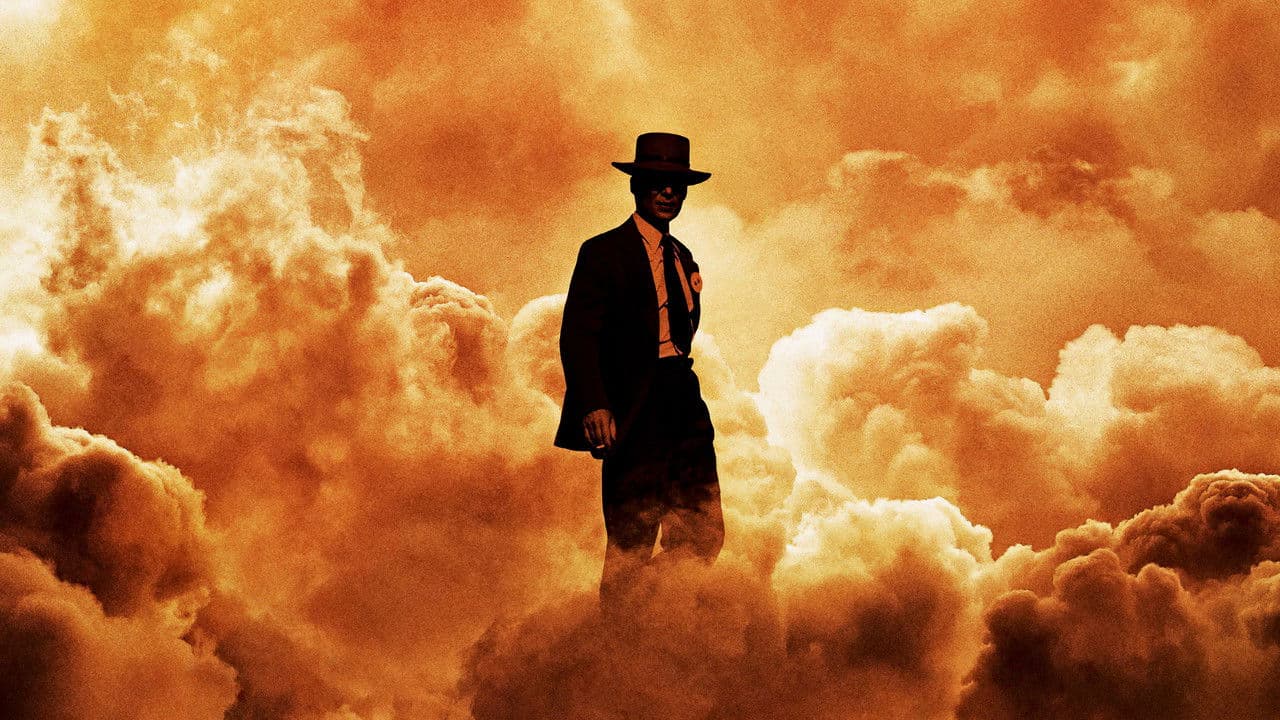
Oppenheimer
Can Karayel • January 15, 2024
Summarize this with AI
Rating
Christopher Nolan crafts one of the most ambitious biographical films in cinema history with Oppenheimer. This epic work penetrates the inner world of J. Robert Oppenheimer — known as the father of the atomic bomb — questioning the moral boundaries of science while delivering a breathtaking audiovisual spectacle.
Among the works Christopher Nolan has given us over the last decade, Oppenheimer is perhaps his most personal and philosophical — a perfect example of how modern cinema's technical capabilities can transform a historical drama into a universal moral question. Adapted from Kai Bird and Martin J. Sherwin's Pulitzer Prize-winning biography American Prometheus, the film tells the story of Julius Robert Oppenheimer, the creator of the atomic bomb, across three distinct timelines, drawing the viewer into the historical facts while simultaneously confronting them with today's technology-versus-ethics dilemma.
The greatest strength of Oppenheimer lies not in presenting the story merely as a scientist's biography, but in framing it as a psychological thriller that explores the darkest corners of human consciousness. Nolan weaves together Oppenheimer's leadership of the Manhattan Project, the subsequent security hearing, and the revenge-driven machinations of his adversary Lewis Strauss in an interlocking narrative. This complex storytelling structure is the most mature iteration of the time-bending techniques Nolan has wielded masterfully since Memento. The film blends color and black-and-white imagery to visualize different perspectives: color sequences represent Oppenheimer's subjective inner world, while black-and-white sequences reflect Strauss's ostensibly objective observations.
Cillian Murphy's performance in the title role is the kind that will go down in history as the pinnacle of a career. Reuniting with Nolan for the fifth time, the Irish actor conveys the character's intellectual genius, emotional fragility, and moral disintegration through minimal facial expression. Murphy carries the storm inside Oppenheimer in his eyes; in the scenes following the Trinity test — the look of mingled fear and horror that crosses his face as he watches the bomb detonate — is just one of the moments that earned him his Oscar nomination. Robert Downey Jr.'s turn as Lewis Strauss is equally the most accomplished work of his career. Completely shedding the charismatic Tony Stark of the Marvel universe, Downey creates a bureaucrat consumed by jealousy and a hunger for power.
The film's technical dimensions bear all the hallmarks of Nolan's cinema. Hoyte van Hoytema's cinematography is breathtaking, particularly in the sequences shot in IMAX format. The Trinity test sequence ranks among the most powerful visual experiences in cinema history; rather than relying on CGI, Nolan simulated a real nuclear detonation using practical effects and miniatures. For this sequence, the crew used real explosives in the New Mexico desert to recreate the visual impact of the atomic bomb. Ludwig Göransson's score, combined with Jennifer Lame's razor-sharp editing, sets the pulse of the film. Göransson blends traditional orchestral instruments with electronic sounds to create the sonic equivalent of the chaos inside Oppenheimer's mind.
One of Oppenheimer's most striking qualities is its use of the scientific process as a cinematic element of suspense. The debates, calculations, and experiments of the physicists at Los Alamos are edited almost like code-breaking sequences from a spy thriller. Nolan employs visual metaphors to explain quantum physics and the fission process; atomic particles dancing through Oppenheimer's mind make abstract science tangible. The film celebrates the beauty of science while laying bare the horror of its consequences.
The behind-the-scenes stories of the film are at least as compelling as the film itself. While making Oppenheimer, Nolan stubbornly insisted on shooting in IMAX 65mm film rather than digital cameras. The crew made history by shooting black-and-white footage with IMAX cameras for the first time, and this technical experiment lent the Strauss sequences a distinctive atmosphere. Another fascinating detail is that all explosions and chemical reactions were captured without CGI, using entirely practical effects. To simulate the Trinity test, Nolan worked with renowned effects designer Scott Fisher, recreating a real nuclear detonation with large-scale miniatures and explosives.
Oppenheimer is not merely a history lesson — it is also a warning for our time. Those of us living in the age of artificial intelligence, biotechnology, and digital surveillance face the same moral dilemma Oppenheimer confronted every day: should science have limits? Should we discover everything we are capable of discovering? Rather than answering these questions, the film invites the viewer to think. As Oppenheimer's famous words — Now I am become Death, the destroyer of worlds — continue to echo at the film's close, we witness a genius crushed beneath a burden that human consciousness was never meant to bear.
For Turkish audiences, Oppenheimer should hold particular resonance, as the film also addresses the influence of great powers over smaller nations and the long-term consequences of historical decisions. This work, which chronicles the dawn of the Cold War, simultaneously illuminates how the geopolitical balances that Turkey itself inhabits were shaped. The destruction of Hiroshima and Nagasaki is a trauma not only for Japan but for all of humanity, and Nolan brings that universal anguish to the screen with tremendous force.
Ultimately, Oppenheimer is Christopher Nolan's most mature and layered work. Despite its three-hour runtime, the film never allows a single moment of boredom, forging a connection with the viewer on both an intellectual and emotional level. Cillian Murphy's career-best performance, Robert Downey Jr.'s transformation, and Emily Blunt's powerful portrayal of Kitty Oppenheimer together elevate this historical drama into a deeply human tragedy. Oppenheimer deserves to be remembered as one of the most important biographical films in cinema history, and it will continue to remind future generations of the responsibility that accompanies the power of science.
Frequently Asked Questions
Is Oppenheimer based on a true story?
Yes, Oppenheimer is based on the true story of J. Robert Oppenheimer, the theoretical physicist who led the Manhattan Project to develop the atomic bomb during World War II. The film is adapted from the biography 'American Prometheus' by Kai Bird and Martin J. Sherwin.
How long is the Oppenheimer movie runtime?
Oppenheimer has a runtime of 3 hours (180 minutes), making it one of Christopher Nolan's longest films. The epic length allows the film to thoroughly explore Oppenheimer's life and the development of the atomic bomb.
Is Oppenheimer worth watching?
With a FoxFilm score of 9.2/10, Oppenheimer is absolutely worth watching as Christopher Nolan delivers one of the most ambitious and penetrating biographical films in cinema history. The film masterfully explores the complex inner world of the father of the atomic bomb.
Did Cillian Murphy win an Oscar for Oppenheimer?
Yes, Cillian Murphy won the Academy Award for Best Actor for his portrayal of J. Robert Oppenheimer at the 2024 Oscars. The film itself won seven Academy Awards total, including Best Picture and Best Director for Christopher Nolan.