Schindler's List
Can Karayel • May 28, 2026
Summarize this with AI
Rating
Schindler's List, the pinnacle of Spielberg's career, is not merely a film but a monument inscribed on the darkest page of human history. This masterpiece, etched into our souls through its black-and-white imagery, stands as a legendary cinematic experience that proves hope can still shine even in the heart of tragedy.
Released in 1993, Schindler's List has cemented itself in cinema history as the most important film Steven Spielberg has ever made. The courage and artistic merit displayed by Hollywood's most commercially successful director in tackling a subject as weighty as the Holocaust became the highest example of cinema's power to preserve collective memory. The film was not merely a drama — it was charged with a documentary mission: to carry the testimony of a tragedy that must never be forgotten forward to future generations.
The true story of Oskar Schindler offers a narrative steeped in the contradictions of the Holocaust. Schindler, a Nazi Party member and opportunistic businessman, opens an enamel factory in Kraków with plans to profit from the war, employing Jewish workers as cheap labor. Yet as he bears witness to the unfolding human catastrophe around him, something shifts within him. Under the influence of accountant Itzhak Stern, portrayed by Ben Kingsley, Schindler's factory quietly transforms into a refuge. Standing in stark contrast to Ralph Fiennes's revulsion-inducing Amon Göth, Schindler risks his fortune and his life to save more than 1,100 people. The screenplay, adapted from Thomas Keneally's novel Schindler's Ark by the masterful pen of Steven Zaillian, earned the Academy Award it so rightfully deserved.
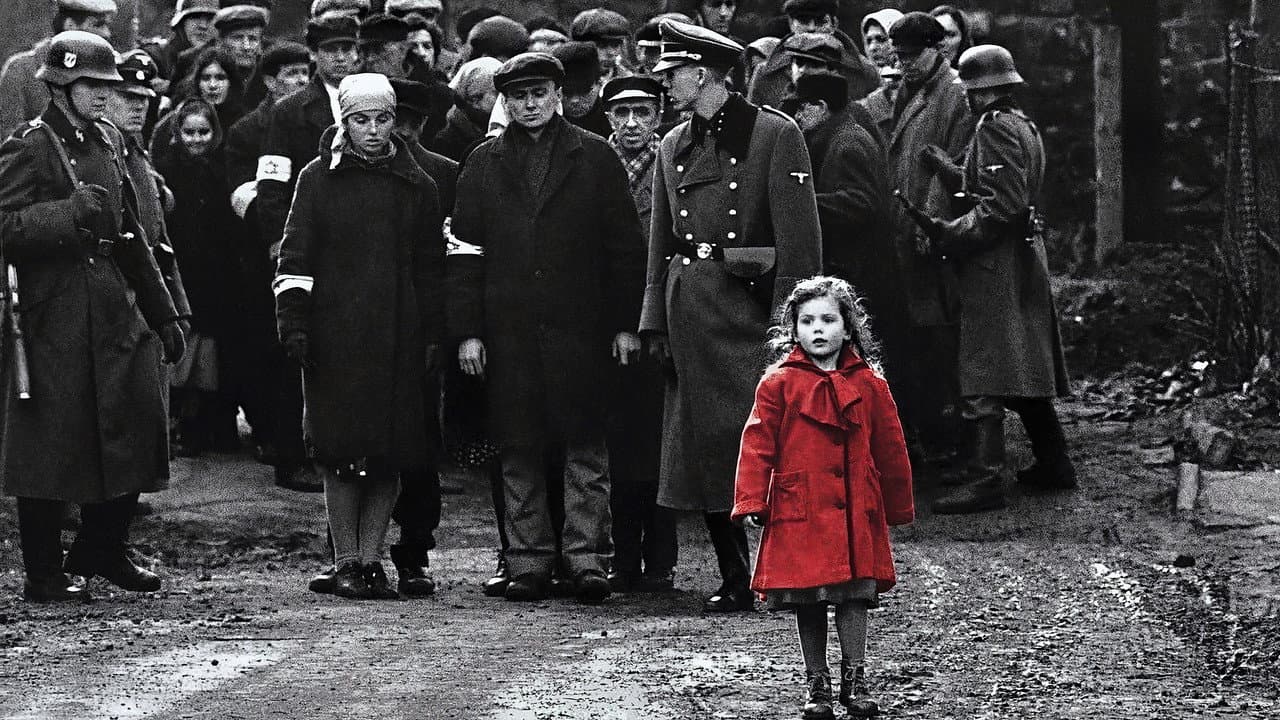
A turning point in Spielberg's directorial career, this film proved that he had stepped beyond his image as a master of entertainment cinema to become a serious artist. The black-and-white visual language he created alongside Janusz Kaminski was not merely an aesthetic choice but a deliberate artistic decision that conjures the sensation of traveling back in time. Kaminski's interplay of light and shadow conveyed the darkness of the Holocaust to the screen while also capturing glimmers of hope in certain scenes. The near-total absence of color throughout the film creates a documentary sense of reality, while the famous scene of the girl in the red coat masterfully harnesses the power of color to underscore the themes of memory and loss.
Liam Neeson's portrayal of Oskar Schindler is widely regarded as the crowning achievement of his career. He crafted a large, charismatic, and enigmatic character while rendering Schindler's inner transformation with subtle, precise detail. Ben Kingsley delivered a breathtaking performance, as always — the character of Stern served as the voice of Schindler's conscience. Ralph Fiennes, meanwhile, created a monstrous yet deeply compelling figure in Amon Göth. The scenes in which Göth shoots prisoners at random from his balcony rank among the most disturbing moments in all of cinema.
John Williams's score is perhaps the most emotionally resonant work of his career. The main theme, performed on violin by Itzhak Perlman, weaves together grief, loss, and hope, burrowing deep into the soul. While Williams is typically known for his grand, sweeping orchestral arrangements, here he embraced a minimalist and deeply sincere approach. The music supports the film's emotional intensity without ever tipping into excess.
The behind-the-scenes story is equally remarkable. Spielberg, a director of Jewish heritage, had long postponed this project, feeling he was not yet ready to take on such a heavy subject. He was so emotionally worn down during filming that he called Robin Williams every day, with Williams lifting his spirits over the phone with jokes. Spielberg took no profit from the film, donating all of his earnings to Holocaust education foundations. The filming locations were the real thing: the ruins of the Płaszów camp, the actual Schindler factory, and the historic Jewish ghetto of Kraków.
One of the film's most gripping sequences is the tension that builds as Schindler stands at the typewriter where the list is being composed, selecting names one by one. Each name is a life; each life, a miracle. The cemetery scene at the finale — in which real-life Schindler survivors and their children visit his grave — creates an unforgettable moment that seamlessly merges documentary and fiction.
Schindler's List is not simply a Holocaust film; it is a universal story demonstrating that hope and goodness remain possible even in humanity's darkest hour. As Spielberg's personal legacy, it has secured its place among the indispensable works of cinema history. When one considers Turkish audiences' own sensitivity to the tragedies of recent history, the film's message — emphasizing human dignity and moral responsibility — resonates with a universal truth. This is a rare work of art that every generation must watch and reflect upon.
Frequently Asked Questions
Is Schindler's List based on a true story?
Yes, Schindler's List is based on the true story of Oskar Schindler, a German industrialist who saved over 1,100 Jewish lives during the Holocaust by employing them in his factories. The film is adapted from Thomas Keneally's novel 'Schindler's Ark,' which documents these historical events.
How many Oscars did Schindler's List win?
Schindler's List won 7 Academy Awards at the 1994 Oscars, including Best Picture, Best Director for Steven Spielberg, Best Adapted Screenplay, Best Original Score, Best Cinematography, Best Film Editing, and Best Art Direction. It was nominated for 12 Oscars in total.
Is Schindler's List worth watching?
Absolutely, with a perfect FoxFilm score of 10.0/10, Schindler's List is considered the pinnacle of Spielberg's career and a monumental cinematic achievement. This powerful Holocaust drama is essential viewing for its historical importance and masterful filmmaking.
Why is Schindler's List filmed in black and white?
Steven Spielberg chose to film Schindler's List in black and white to give it a timeless, documentary-like quality that evokes the historical footage and photographs from the Holocaust era. The artistic choice also adds to the film's somber tone and helps distinguish it from typical Hollywood productions.